
The 2026 US midterm elections have brought a significant shift in Washington’s political landscape, with implications extending well beyond American politics.
From the outlook for global financial markets and geopolitical relations to the future of artificial intelligence and infrastructure investment, the election results introduce new considerations for investors.
We examine what these developments could mean for markets, where risks may emerge, and the investment opportunities that could arise as the political and economic landscape evolves.
US Politics:
The US midterm elections delivered a decisive political shift, with Democrats taking control of both the House of Representatives and Senate in what has been widely interpreted as a referendum on the cost of living, the economy and the ongoing Iran conflict. The result ends two years of unified Republican control and gives Democrats significant powers to investigate the administration, control congressional committees, influence funding and block presidential nominees. It does not, however, give Democrats the ability to dictate policy, President Trump retains veto power, making a period of political gridlock more likely than a wholesale reversal of the administration’s agenda. For investors, this distinction is important. The election increases scrutiny of government spending, immigration, defence and technology policy, while making major new legislation more difficult to pass. The market’s initial response has been relatively constructive, suggesting investors view the result less as a fundamental economic shock and more as a reduction in the risk of further significant policy changes from Washington.
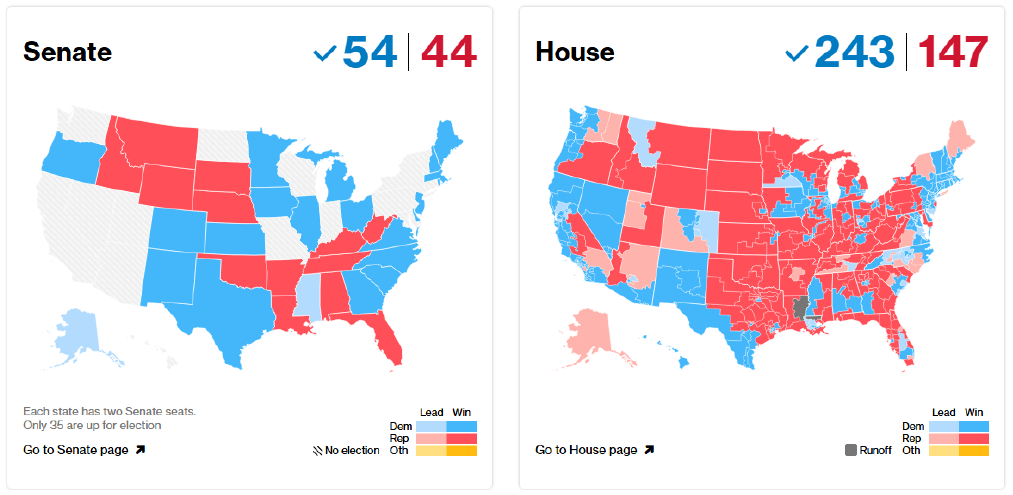
Source: Bloomberg
Geopolitics:
The election is unlikely to produce an immediate reversal of US foreign policy, but it introduces greater friction around the administration’s approach to Iran, trade and international alliances. Democrats have already indicated that they will challenge further funding for the Iran campaign, creating the prospect of prolonged disputes over war powers and appropriations rather than an immediate end to the conflict. Similarly, Trump’s tariff programme is unlikely to disappear simply because Democrats control Congress; the President retains considerable executive authority over trade and Democrats lack the votes required to override a presidential veto. The more important change is therefore one of constraint and oversight. Allies and trading partners may become more willing to test the administration’s resolve, while Washington’s negotiating stance could become more difficult to predict. The Middle East remains particularly important for markets given the implications for oil supply and inflation. Trump’s announcement that US financial support for Israel will end after 2026 also introduces another element of uncertainty, although the practical implementation remains unclear given the existing US-Israel funding agreement.
“Houston, we have a data centre problem!”
Equity Markets & AI:
The most immediate market consequence has been a notable divergence within the technology sector. Broad US equity markets rallied as investors interpreted the result as reducing the probability of further aggressive policy shifts, while companies directly exposed to the physical AI buildout, particularly data-centre operators, power infrastructure and some smaller AI infrastructure companies, came under pressure. This reflects a growing distinction between AI demand and the ability to build the infrastructure required to meet that demand. Democratic victories in Texas, Georgia and other important data-centre states strengthen local opposition to projects because of concerns over electricity consumption, water usage, grid capacity and the benefits to local communities. This could slow the pace of the AI infrastructure buildout without necessarily reducing the underlying demand for computing. Interestingly, this may favour the largest technology platforms: Amazon, Alphabet, Microsoft and Meta all rallied as investors considered whether tighter infrastructure supply could reduce their capital-spending burden and strengthen their competitive position. For equity investors, therefore, the election is less a challenge to the AI investment thesis than a potential change in where the value accrues. We would expect greater scrutiny of data-centre construction and power requirements, with leveraged infrastructure providers potentially most vulnerable to delays, while well-capitalised technology platforms, semiconductor leaders and companies supplying the broader AI value chain remain better positioned.
*Source: Activ8 Portfolio Management, Claude AI
Our Investment Houseview:
From an investment perspective, the outcome reinforces several of the themes within our current houseview. We continue to favour China and broader Asian markets, where valuations remain more compelling and where improving domestic demand, policy support and the region’s growing importance within the global technology supply chain offer a differentiated source of potential returns. We also remain constructive on commodities, particularly where constrained supply meets structural demand from electrification, energy infrastructure and the ongoing AI buildout. More broadly, we believe the changing political and market backdrop is beginning to create opportunities beyond the areas that have dominated investor attention in recent years. Parts of the market that have been overlooked, heavily discounted or simply lacked the excitement associated with AI continue to offer deeper value, with healthcare and selected consumer-facing businesses among the areas where we see the potential for improving fundamentals to be better reflected in valuations. Our preference is therefore not to move from one concentrated theme to another, but to broaden the opportunity set and look for mispriced assets where expectations appear more favourable than current valuations suggest. In our view, this creates an increasingly attractive environment for selective exposure to China, commodities and under-owned areas of global equities, while maintaining exposure to the structural winners of the AI cycle.
To partner with Activ8 or find out more about our work, visit
